
When the renovated UVM Alumni House had its grand (re-)opening in September 2016, its opulent and grandeur were readily apparent.
The 18,000 square-foot Queen Anne-style mansion boasted richly colored stained glass, expertly joined woodwork built of golden oak, white oak, mahogany, and sycamore, ballrooms, intricate carvings, and even a restored 1926 Mason Hamlin piano.
Less obvious may have been the dedicated efforts of the hundreds who brought this vision to life: the Delta Psi fraternity brothers, alumni, donors, University partners, craftspeople and friends who dedicated themselves to the project of creating a space for UVM alumni to call home, in what is recognized as one of Vermont’s most stunning buildings.
We spoke with Associate Vice President of Alumni Relations Sarah Lenes and a few key project leaders to learn about some of the stories and highlights that brought us to this anniversary. In no special order, here are our top ten favorite ones in honor of the milestone.
1. 61 Summit Street is a Historic Gem


Alumni House's Ader Hall through the years: left-to-right: a vintage image, the architectural rendering from the renovation project, and the restored space today.
The sprawling mansion was first built in 1891, to fulfill the vision of Burlington manufacturing magnate and banker Edward Wills. He wanted to build the finest residence in the Queen City on Burlington’s most beautiful building lot, and by all accounts, this is just what he achieved.
Admirers, visitors and Delta Psi fraternity brothers who lived in the house knew that they were living in a rare treasure. Bas-relief wood carvings, the covered coach-door entrance (a “porte cochere”), the richly colored stained glass, rooms finished in a panoply of woods — this was no ordinary residence. This was a special opportunity worth the complexity and the cost.
2. Building in Honor of the Past, the Present and the Future


From the very beginning, the House became a place for both practical use and celebration. Left-to-right: an early group of visitors, poses with a UVM banner, all is ready for the groundbreaking, and Cathy Tremblay '85 and Jeff Schulman '89 pose with the newly arrived Catamount statue.
The teams who worked on the project — from the university administrators to those who secured the funding, the volunteers who kept the right people informed and the project on track, the craftspeople who dedicated themselves to honoring the recreation of some of the state’s most beautiful features to reside in any building — had much to balance. Costs had to be contained. Uses of the building had to be managed and negotiated. Nothing like this had existed for UVM before, and, together, the team had to imagine what might be possible.
3. How a Vision Became this Enduring Structure
It took many, many meetings and conversations to develop a plan that would deliver what everyone wanted. The Delta Psi brothers, who had deep history there, having owned the building for nearly 100 years, advocated to have continued, limited, access to the space.
University and fundraising officials knew that a showplace building would create opportunities for the most special of events, and a way to make any visiting alumnus feel pride in their affiliation with their alma mater. Detail after detail had to be considered, and they were, thanks to the tireless involvement of many.
4. A Special Relationship with Delta Psi Fraternity Made It Possible



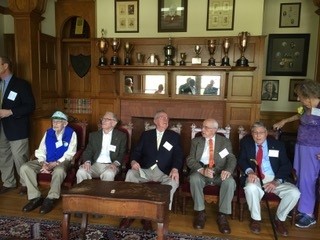
Left-to-right: Delta Psi brothers at the groundbreaking, gathered on the second-floor balcony, a mixed-generation group inside the building at the grand opening, and some of those brothers inside the Brothers' Room, courtesy John Irish '73.
When Delta Psi decided to sell 61 Summit Street, they were sure of one thing: they hoped the building could remain with UVM.
Delta Psi brother John Irish ’73 talked about that decision, and what it has meant, in a recent conversation.
“For the building to become UVM’s Alumni House helped our chapter to accomplish some very important parts of our legacy. Selling the building to UVM meant that this building, which we all cared so much about, would restored to its appropriate state. And it helped us establish a legacy for Delta Psi in two ways. First, we were able to create the Brothers’ Room, a fully restored and maintained space that any visiting brother can enter. “Anybody coming back to Burlington, no matter how long it’s been, they have a place to go,” he told us. “You get flooded with memories. You remember the connections and the friendships you made.”
That room is important to brothers of the fraternity, but they take a great deal of pride in the second part of Delta Psi’s legacy. John explained, “When we sold the house and got some money, we set up a special endowment that we were able to access once the renovation was complete and the fund started to pay out. That endowment pays scholarships for any descendant of a Delta Psi brother. Right now, we’re paying 11 or 12 scholarships for current students. And we are proud of that.”
5. It Was a Vision that Donors Turned into Reality

The Wolfgang and Barbara Mieder Emeriti Faculty Lounge was created by the involvement of more than 20 generous faculty members, and is in regular use by grateful faculty today.
Professor Emeritus Wolfgang Mieder was a volunteer through the ups and downs of the project. He and fellow volunteers learned about some of the unique challenges that are part of an endeavor like this one, including what funding was possible and needed.
Wolfgang remembered, "The Foundation’s Kathleen Kelleher and Alan Ryea explained to our committee about the idea of a donor pyramid, meaning that we plan to ask people to give what they can. For some people that’s quite a bit, and for a professorial type like myself, it meant we’d give less. After thinking about it, that was how my wife Barbara and I came to make a fairly modest gift to name the space that’s now used to host small faculty events," (which is now known as the Mieder Emeritus Faculty Room). Wolfgang has the pleasure of hearing from colleagues when they use the room for meetings, or to review academic publications, or other academic uses.
The building is the only one in UVM’s history to be funded entirely by philanthropy, a point of pride for Wolfgang and for many others who worked to bring it into being.
“The nice part of this, “ Wolfgang observed, was that, “from a money-raising point of view, whoever decided to be part of the project could afford it. It didn't make any difference whether you gave $5 or $5,000 or much more. Those are the tricks of the trade that make such enormous things possible.”
6. Because of the Dedication of Volunteers and Leadership
Dignitaries, donors, partners, volunteers and guests at the 2016 grand opening.
The most important aspect of the Alumni House, emphasized Sarah, is the sustained collaboration and commitment that the project required.
“The levels of research and work that went into its creation can’t be exaggerated,” she said. “The Alumni Association and our alumni constituents were vital in the actual creation of the building, from the concept to the collaboration with university administration, to the fundraising piece of the facility, to the operations once it was built – none of this could have happened without the incredible dedication of many, many people.”
Dan Fogel, who was UVM’s president throughout the years of planning, visioning, designing and building, deserves much credit, says John Irish plainly, “I want to thank Dan Fogel for getting the deal done. He told us what UVM would do and he made sure it happened. It took a lot of meetings and a lot of time for it to come together in the way we wanted and hoped it would. And he made sure it did.”
Rachel Fogel, married to Dan, played a longtime important role too, said Wolfgang. “She and I spent many hours in meetings talking about all the details that would come up, from building questions to how to plan food for events. These things take a lot of time.”
7. It’s Accessible to All Alumni

The building has modern amenities for comfort and accessibility, including ramps to get into the building and an elevator to move easily between its floors.
These new features have made the building welcoming for hundreds of people with any kind of mobility impairment.
They also led to one of Sarah’s favorite stories of her time in the space so far.
“Having alums come home to their special place, is always so moving. But in this physical space, when the Delta Psi brothers from any decade return home, it's especially meaningful," she said.
“One very special example from years ago when we opened the facility, we had a brother return home who, after graduating, had begun using a wheelchair. He was back on campus because his grandson was graduating and his wife reached out to ask if they could come see the renovated house.
“Of course, I said, ‘Absolutely!’ I met them outside the building, on the Saturday before commencement, and said, ‘Okay, let's go inside.’ And the gentleman looked at me and said, ‘I can't get inside.’ I said, ‘Yes, we can. Now we have a ramp.’
“So inside the door we went, to the first floor, where we toured around. And then I said, ‘Let's go up to the Brothers’ Room.’ He said, ‘I can't, Sarah. I'm right here in this wheelchair.’ So then I told him about the elevator, and how we had repurposed the old dumbwaiter shaft, and how anyone could now get onto the second floor. So not only could I get him onto the second floor, but he could get into the Brothers’ Room, a space that is so important to the Delta Psi brothers, and one he had accepted he was never going to be able to go into ever again because of his physical restrictions.
“We did that and then were able to get out onto the balcony and see that wonderful view – and this was all because of the fact that we took this facility and kept the beautiful bones. But we also allowed it to become and wanted it to become accessible for all.
“And the gift that we were able to give this one alum will always remain with me as the why we do what we do when we renovate historical buildings, why we partner with different departments on our campus, including the Historical Preservation Group and Historical Preservation Burlington, because it allows for us to take these beautiful buildings, use creativity, invest financially, and make them accessible for everyone.”
8. You Can Take a Virtual Tour

And if you’re not on campus, you can click through to have a digital look at the spaces. (Though we hope we’ll get to see you in Burlington for the real thing when you’re able!)
9. Even Better: You Can See It in Person

The Maple Street entrance to the house, right under the porte cochere.
Alumni are welcome any time.
Generally, we’ve got staff in the space Monday through Friday, 8:00 a.m. through 4:30 p.m. Drop-ins are most welcome, says Sarah. (Though it’s a good idea to call or email ahead just to make sure your visit doesn’t coincide with one of the times the building isn’t open to the public.)
Whenever you come, you’re welcome to wander around and see what the renovated spaces look like.
Sarah says, “You can meet staff, and when students are around, you can interact with them. Our hope is to be a place you can count on to get an update on what's happening at the university, be that cornerstone for your visit back to campus.” She especially invites alumni to visit the libraries on the first floor: the Newton Library, which has alumni-authored books, and the Mieder room mentioned above.
10. Much More Than the Sum of Its (Many!) Parts

One of the early events hosted in the space shortly after opening: the Mosaic Center for Students of Color Breakfast, which remains a beloved annual tradition for the Foundation.
Ten years in, UVM has something that few universities do: a gracious, grand, accessible building that was made possible with philanthropy, a center of celebration, learning, and relationship-building, right alongside the work that goes into maintaining and supporting the remarkable place of higher education that we are. In those years, it’s seen countless gala events, helped us recognize extraordinary achievements, hosted retreats and meetings, seen athletics watch parties and season selection events, featured many addresses by university leadership, and even seen its share of weddings.
What have your favorite Alumni House events been? We’d love to know. And even more, we’d love to see you there soon and we hope that we will.
Celebrating 10 Years of UVM's Alumni House
Cheryl Carmi
September 10, 2026